

All In: The Life and Legacy of Heman the Son of Joel
Written by Bill Valine
“Even though Heman did not have the best example, he strove to be the best he could be. Yet he did not succeed simply because he was talented. Although, he had a famous grandfather, he did not live off of Samuel’s reputation. He was all in. He seized opportunities to serve God whenever they arose.”
When a poker player has an unbeatable hand, he will be ready to bet whatever it takes to win that hand, to wager everything he has, leaving nothing in reserve. He will push all his chips into the pot: that he would go all in. In the Bible, it can be said that Heman, the son of Joel, was all in, that he was totally committed to serving his God.
Heman was an extraordinary man. He is mentioned some 14 times in the Bible. He was a singer in the temple (1Chr 6:33). He was a leader of the temple musicians (1Chr 15:19, 1Chr 16:41 - 42). He spoke for God (1Chr 25:1, 1Chr 25:5). And he was an advisor to King David (1Chr 25:5).
One might think, “With that much talent, of course, he was used by God.” But his service to God was not guaranteed. His father was Joel, son of Samuel (1Chr 6:33). Samuel was honest and had not used his position to take advantage of the people (1Sam 12:4), yet Joel took bribes and perverted justice (1 Sam 8:3). Heman chose to be more like his grandfather, Samuel, and his great-grandmother, Hannah, than his wicked father, Joel.
Even though Heman did not have the best example, he strove to be the best he could be. Yet he did not succeed simply because he was talented. And although he had a famous grandfather, he did not live off of Samuel’s reputation. He was all in. He seized opportunities to serve God whenever they arose.
At the same time, he did not show signs of ambition. On the contrary, Heman had a good reputation among his peers. When David asked the Levites to choose men to be singers in the temple worship, they chose Heman first, then Asaph and Ethan (1Chr 15:17).
Heman lived up to his name, which meant faithful. And he left a lasting legacy that affected his descendants for many generations. His sons (1 Chr 25:4-5) and his grandsons (1Chr 25: 13, 16, and 22 - 31) joined him as singers in the temple. His family members were active in the temple during Hezekiah’s reign, more than 250 years after Heman’s lifetime (2Chr 29:14). And Asaph, Heman, and Jeduthun (1Chr 25:1) were still spoken of in Josiah’s day, some 75 years after Hezekiah (2Chr 35:15).
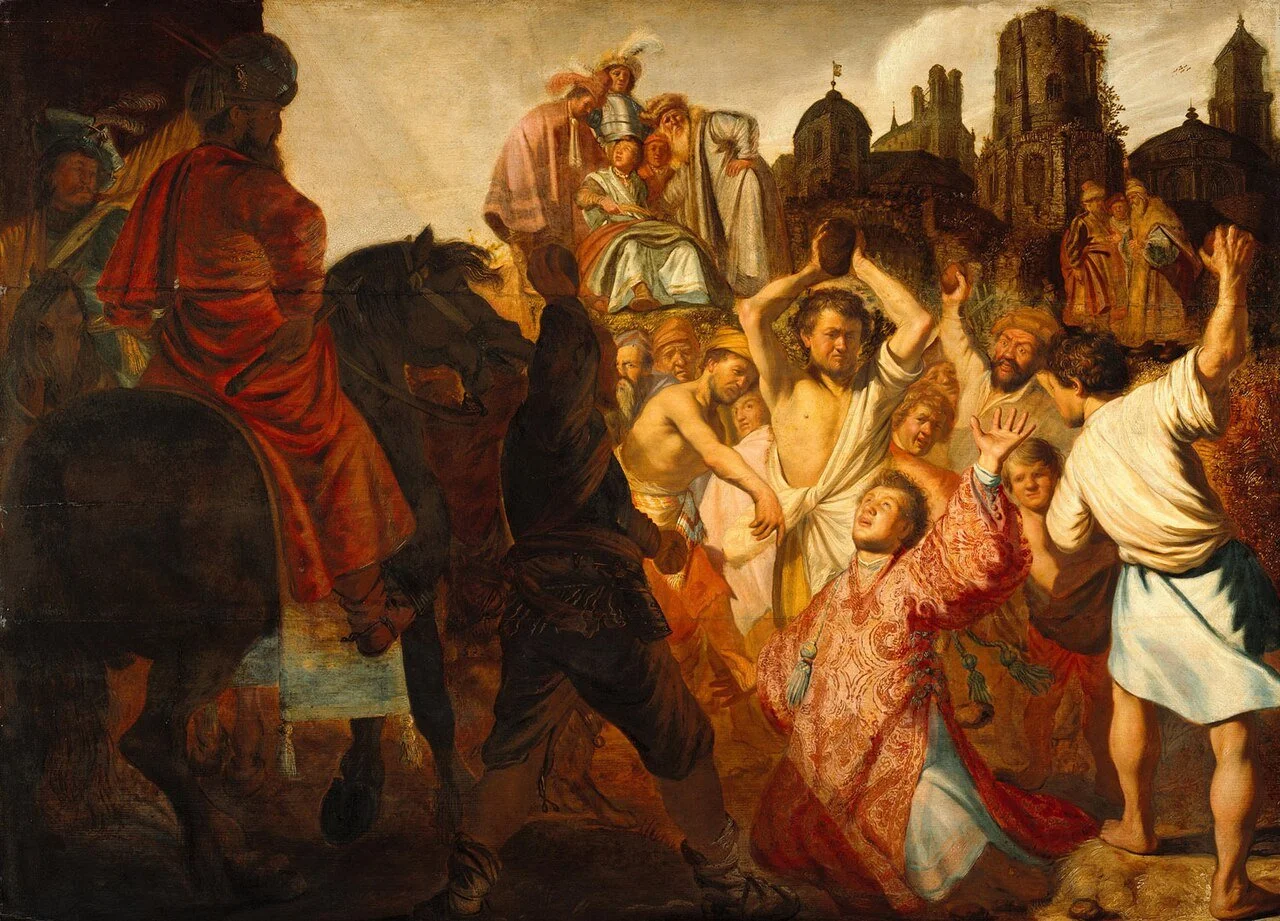
The Stoning of Saint Stephen, Rembrandt 1625
In the New Testament, Stephen was a man who was all in. In the book of Acts, chapter 6, a need arose for serving widows amongst the community of believers in Jerusalem. When the Apostles asked the people to appoint seven men to serve those widows, the first person chosen was Stephen.
Stephen was “a man full of faith and the Holy Spirit.” His life showed that he believed in Jesus and acted accordingly, to the point that the people around him could see that he was anointed by God. It was obvious that he had been faithful in serving the needs of others since the Christians in Jerusalem thought of him first when considering who would be chosen to serve the widows. And the faithful performance of his duties opened up more opportunities to be used by God: after he was appointed, God used him to perform miracles; Stephen was a man of wisdom who testified powerfully for Jesus Christ; and finally, Stephen was seen to be all in because he trusted Jesus even in his death.
Two people who are all in are much closer to home. At my church, I have a good friend, Charles Seaman, who was in the Air Force. After many years being stationed at Davis Monthan Air Force Base, he was transferred to bases in Alaska and North Dakota. After 13 years, he and his wife Pat were able to move back to Tucson. You might think that after such a long time away, they would not be able to readily find ways to help at the church, but the truth is just the opposite. Pat had helped with the children in the various churches they had attended, and she quickly found tasks to perform that were helpful in our children’s church. And even twenty-one years later, she and Charles are still helping out in the weekly services of our children’s church.
Heman, Stephen, and even Charles and Pat are examples of people who are all in. Like them, we, too, can be all in. We do not need to be extremely talented. Nor do we have to be perfect. Our commitment to Jesus simply needs to be complete. So how can we be all in? By being fully committed to a local church. It is in the church that we will readily find opportunities to serve, if we look for them. We may not receive recognition in our lifetimes, but we can be sure that God takes notice of our efforts (Mt 20:26-28). And we can be sure that God will help us as we serve others (Acts 20:35). By serving others, we will be creating, like Heman, a legacy for our descendants for generations.
1 Heman was first brought to my attention in a sermon by Mike Webb, November 30, 2025.