

Algorithmic Culture and the Curse of Babel
Written by Jessica Greer
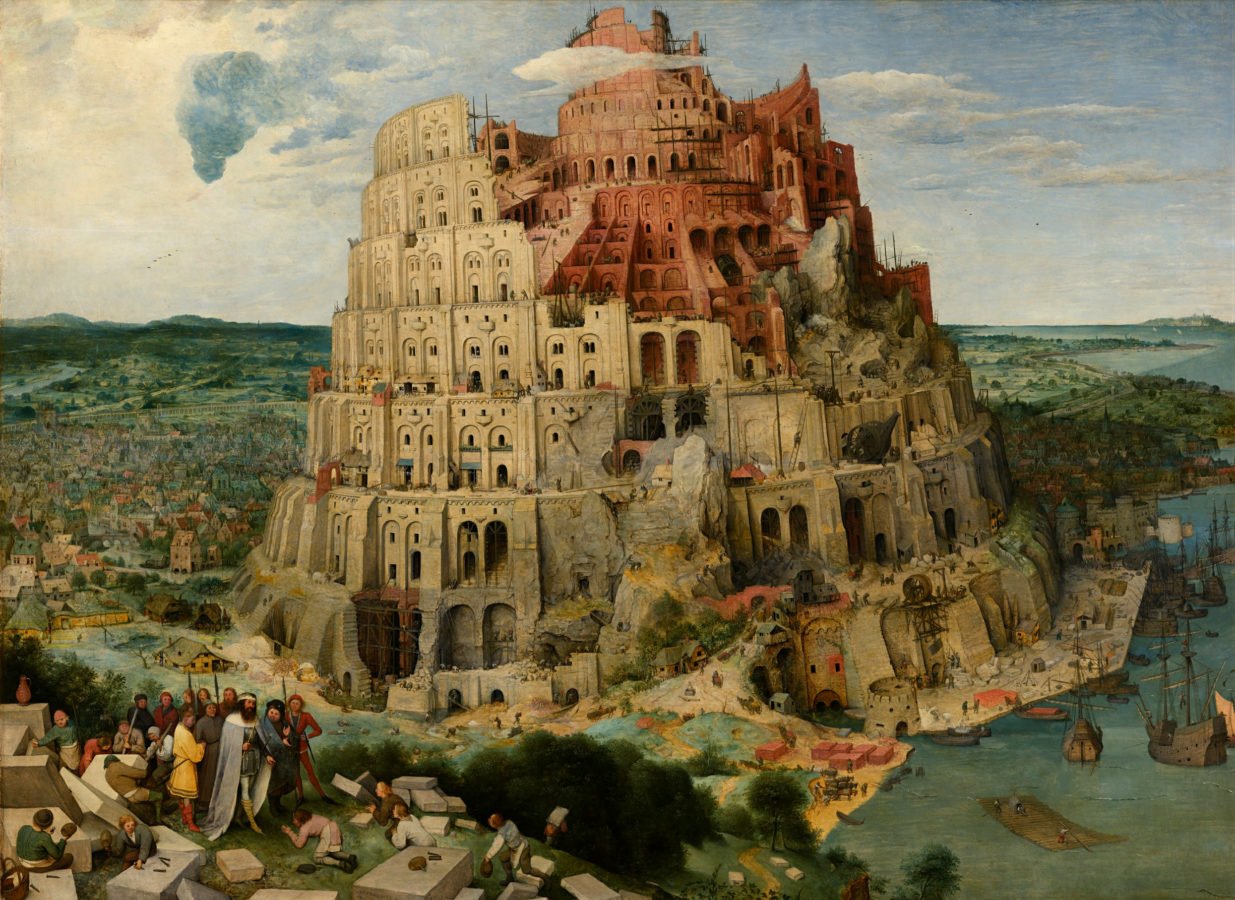
Pieter Brueghel the Elder, The Tower of Babel, c. 1563, Kunsthistorisches Museum, Vienna, Austria.
Currently, we are living through what feels like a tunnel of angst, a sort of dark age in which history is as absent from our sight as the present world around us. Violent tensions erupt almost in harmony, singing the same wicked tune. Wars dehumanize both the hero and the perpetrator. Ideological radicalization infects weak-minded men, drawing them into deceptive traps. Is this what the collision between the end of one century and the beginning of another feels like?
While smart technology increases at an unprecedented speed, first-world countries drown in decadence, hedonism, and the stultification of critical thinking. The total pursuit of self at all costs eats at the eternity placed in the hearts of men. A kind of cognitive dissonance, or moral schizophrenia, torments the most advanced societies as we strive day and night to add our layer to fallen humanity’s ongoing Tower of Babel.
Bizzaro technocrats like Peter Thiel lead this Babel culture into transhumanistic idolatry, prophesying of a day when technology will be able to “renew our minds daily,” transforming us from mortal men to immortal beings. This may sound like a paranoid Luddite, resisting the inevitable days to come. However, there is one indicator that our Babylonian enterprise is surely in crisis, and even operating under the curse of Babel.
Genesis 11:3-8, 3 “They said to each other, “Come, let’s make bricks and bake them thoroughly.” They used brick instead of stone, and tar for mortar. 4 Then they said, “Come, let us build ourselves a city, with a tower that reaches to the heavens, so that we may make a name for ourselves; otherwise we will be scattered over the face of the whole earth.” 5 But the Lord came down to see the city and the tower the people were building. 6 The Lord said, “If as one people speaking the same language they have begun to do this, then nothing they plan to do will be impossible for them. 7 Come, let us go down and confuse their language so they will not understand each other.” 8 So the Lord scattered them from there over all the earth, and they stopped building the city.”
The irony, to create a faux global unity in order to maintain human security, power structure, and collective creativity as a means to prevent the “scattering” of people, only to be completely sabotaged by confusion resulting in the scattering of all people. Man’s wild efforts to take matters into his own hands, against the knowledge of God, in order to protect himself from his greatest insecurity, led directly to the fruition of that fear.
Jonathan Haidt, renowned for his books on analyzing teen depression and anxiety correlated to social media and smartphones, generalizes the impact of technology, but fails to understand the causation of “why”.
Why are we prone to this elixir? Why has half the country taken up a career in the social pseudosciences? Why is depression on the rise when we are being flooded with mental health and wellness professionals at a historic rate? Nietzsche's brilliant “God is dead” observation is the answer. All we have left is to toil in our dark wilderness of the subjective. Mass confusion. Narratives, the subjective, and algorithms are all manifestations of being scattered.
The story of Babel tells us of a judgment that scattered people while they imagined themselves to be building a tower reaching into the heavens. What is Babel? It is technology, advancement, human ingenuity, and collaboration employed to construct an alternative reality—one that seeks to rival God’s authority. Babel later becomes Babylon, and the book of Revelation refers to the judgment of all mankind's efforts to build a great city: powerful, decadent, industrious, and self-sufficient. Reflecting the ultimate form of rebellion, defiance, and pride. The judgment is separation. Ultimately, God's final judgment of sin will be separation from God Himself.
Flip scattering into unity. What truly unites people? Movements? Politics? Ideas? Skin color? Shared history? None of these can bear the weight of genuine unity. 1 Corinthians 1:10: "Now I urge you, brothers and sisters, by the name of our Lord Jesus Christ, that all of you agree in what you say and that there be no divisions among you, but that you be united in the same mind and in the same purpose." Objective truth. A shared reality. One purpose.
God's curse upon Babel led to scattering and isolation, leading to a dark age, a reset of civilization. We are living amongst pseudo-communities and faux families. People are increasingly bound together not by truth, but by subjective narratives constantly being cultivated, affirmed, and "yass queened" by algorithms. In reality, people are scattered. They do not share the same truth, nor even the same objective understanding of reality.
How many breaking news stories emerge of young people committing suicide or horrific crimes to the shock and astonishment of their own parents and families? Parents are blindsided by the radicalization and indoctrination of their children, by a device. Scattered.
God's intention is altogether different. We are called into the Body of Christ—individuals sharing, witnessing, united, in agreement, of one mind. Men have a great capacity and untapped potential to organize, create, and build. However, against the oneness of God, it is futile and vain. Psalm 127:1,: "Unless the LORD builds the house, those who build it labor in vain."