

Time Will Tell!
Guest Blog Written by Ps. Stuart M. Reblin

Media networks are often given a 2-minute advance notice by administrative coordinators when a presidential announcement or press briefing is about to occur. This cues the network to adequately prepare and seamlessly divert from scheduled programming to capture the special event in real time. What if humanity – living life as regularly scheduled, is being given a similar warning right now?
For decades, Christians have declared: Jesus is coming! Get ready! Personally, I’ve been waiting for the “event” to begin for over 50 years–as have many others. That’s a long two minutes! But something feels different! The pace of global events is accelerating. Nations are shifting. Uncertainty is rising. And questions surrounding the Last Days feel immediate, personal, and urgent.
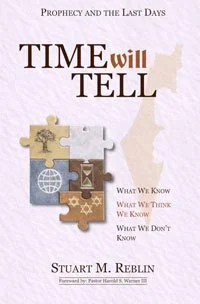
Time Will Tell… What We Know, What We Think We Know, What We Don’t Know (a book on Prophecy and the Last Days, by Pastor Stuart Reblin) will be available in late May 2026. This book does not sensationalize prophetic hypotheticals, force conclusions, or make dogmatic arguments concerning uncertainties, but provides solid Scriptural basis upon which each individual can develop personal convictions relating to the Last Days.
There are many elements associated with the Last Days that we cannot perfectly identify. The Apostle Paul stated correctly: “We see through a glass darkly.” Nevertheless, the significance of current world events should not be casually dismissed as just another day at the office. I believe we are a prophetic generation; living on the precipice of eternity. The reality of Christ’s imminent return for His church via the Rapture is a very real prospect! And yes, this has been a consistent phrase ever since the day I gave my life to Jesus, over 50 years ago! In fact, the anticipation of Christ’s return extends back to the days following Christ’s ascension!
“Maranatha! The Lord is coming! In the Early Church, this was more than a phrase.”

Maranatha! The Lord is coming! In the Early Church, this was more than a phrase. It was a mindset–the steady awareness that Christ could return at any moment. It carried both anticipation and urgency—an expectation that shaped how believers lived, thought, and hoped. The exclamation was often followed with, “Gather us all together into Your Kingdom which You have prepared! Maranatha! Hosanna to the Son of David! Blessed is He that cometh!”
That same excited expectation should define believers today. Scripture consistently points us toward this posture of watchfulness. The New Testament repeatedly uses language that calls believers to look, to wait, and to expect. These are not passive words. They describe a heart that is engaged—alert, ready, and anchored in hope.
How do all the pieces of the prophetic puzzle fit together? We can’t know for certain. But believers are called to pay attention to the world’s changing barometric pressures, exercise sound spiritual discernment, communicate warnings as biblically warranted, and live accordingly.
Jesus rebuked the Pharisees and Sadducees because they could interpret the weather but failed to discern the spiritual significance of their time. Jesus said: “When evening comes, you say, ‘It will be fair weather, for the sky is red,’ and in the morning, ‘Today it will be stormy, for the sky is red and overcast.’ You know how to interpret the appearance of the sky, but you cannot interpret the signs of the times” (Matthew 16:2-3 NIV).
“However, the issue of spiritual dullness reaches across the aisle.”
The context of Jesus’ rebuke dealt largely with His detractor’s scriptural ignorance and animosity toward His identity as the promised Messiah. However, the issue of spiritual dullness reaches across the aisle. In 1 Chronicles 12:32, God’s Word commends the children of Issachar as “men that had understanding of the times, to know what Israel ought to do.” Discerning and appropriating world events into God’s prophetic puzzle may not be a perfect science, but the admonitions to watch and prepare occur throughout Scripture.
God’s Word identifies potential hazards to the life of faith with the passing of time. Daily pressures and worldly distractions can replace spiritual urgency with complacency. Luke 21:34 says: “But take heed to yourselves, lest your hearts be weighed down with carousing, drunkenness, and cares of this life, and that Day come on you unexpectedly.” A loss of expectancy can lead to cynicism and carnality (Matthew 24:48-51). Faith rooted only in emotion cannot endure; it must be grounded in relationship with Christ and His Word. This great truth is illustrated in the Parable of the Sower. Jesus said, “The seed falling on rocky ground refers to someone who hears the word and at once receives it with joy. But since they have no root, they last only a short time. When trouble or persecution comes because of the word, they quickly fall away” (Matthew 13:20-21 NIV).
“Daily pressures and worldly distractions can replace spiritual urgency with complacency.”

The human personality struggles to maintain resilience when faced with prolonged delays. Romans 8:23-24 says, “Even we ourselves groan within ourselves, waiting for the adoption, to wit, the redemption of our body. For we are saved by hope.” But “hope deferred makes the heart sick” (Proverbs 13:12). The Hebrew word for deferred is mashak, meaningto prolong or delay. The Hebrew word for sick is chalah, which means rubbed or worn down; weak or afflicted. Despite difficulties, perseverance is essential.
Faith must remain anchored—not in timelines, but in truth. Peter in chapter 1 of his first epistle provides a successful strategy for enduring the waiting game: (i) remember that you have an eternal inheritance (1 Peter 1:4); (ii) God’s power will faithfully sustain you through temptations and the trials of your faith (v. 5-7); (iii) faith and joy will be your strength (v. 8-9); (iv) never lose appreciation for the unspeakable gift of salvation which you possess, as it represents the envy of Old Testament prophets and even angels (v. 10-12); (v) encourage yourselves! (v. 13); (vi) obey the Lord and pursue holiness (v. 14-16); (vii) pray and walk with reverence before the Lord (v. 17).
Our confidence in Christ’s return is not built on speculation, on what we know or what we think we know, on trends, or even on visible signs alone. It is built on the unshakable foundation of faith (Galatians 3:11). Faith does not require complete understanding. It rests in the character and promises of God. Jesus Himself said, “I will come again.” That is enough! “Let not your heart be troubled: ye believe in God, believe also in me. In my Father’s house there are many mansions: if it were not so, I would have told you. I go to prepare a place for you. And if I go and prepare a place for you, I will come again, and receive you to myself; that where I am, there ye may be also” (John 14:1-3).
“Our confidence in Christ’s return is not built on speculation, on what we know or what we think we know, on trends, or even on visible signs alone.”
Time Will Tell examines: Familiar Prophetic Phrases, Signs of the Times, Jerusalem and Israel, the Fig Tree and A Final Generation, Daniel’s 70-week Prophecy, the Gog/Magog War, the Day of the Lord and the Day of the Lord Jesus Christ, the Rapture and the Bema Seat, and victorious Christian living.