

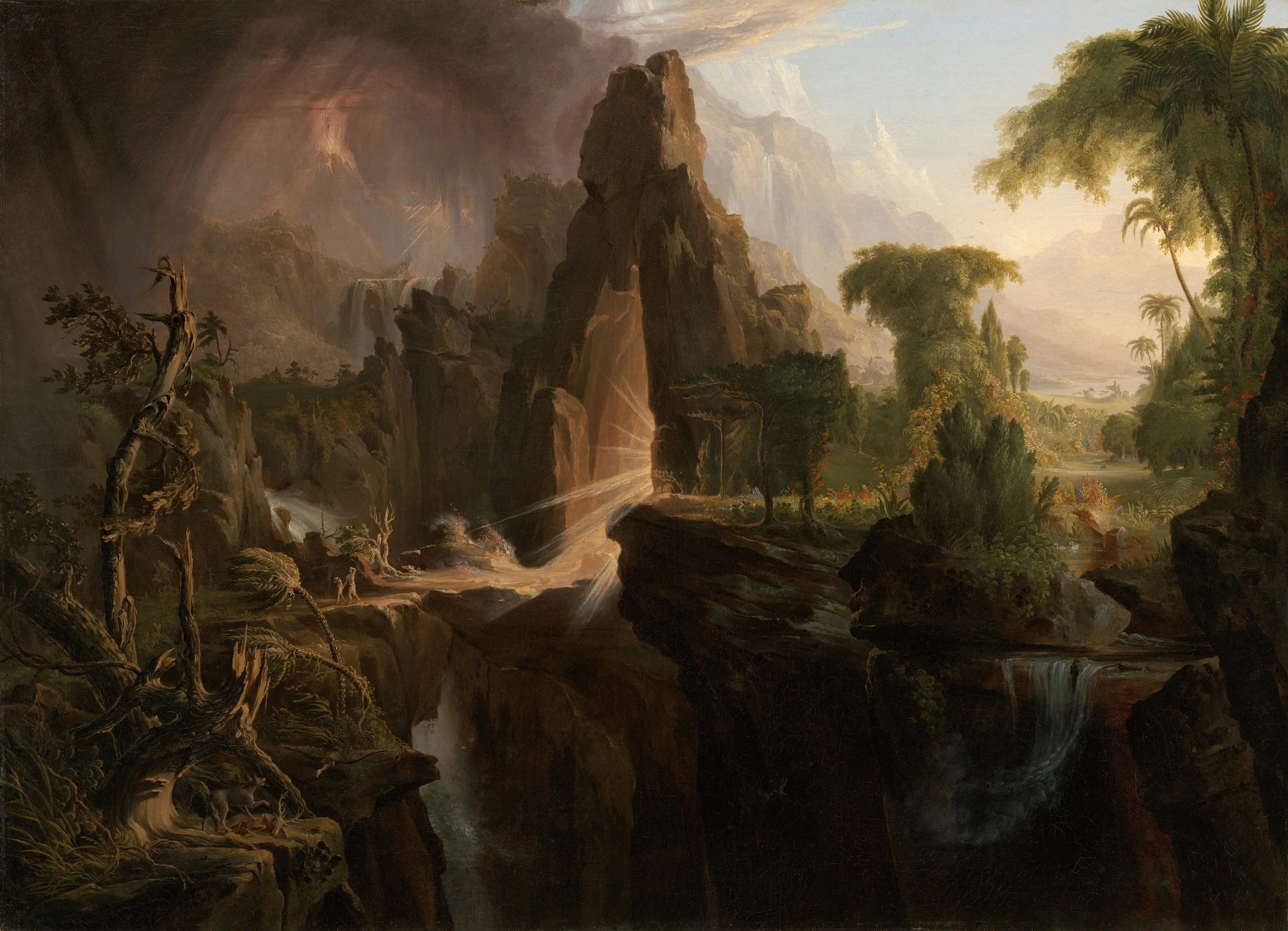
“Expulsion from the Garden”, Thomas Cole 1828
“So He drove out the man; and He placed cherubim at the east of the Garden of Eden, and a flaming sword which turned every way, to guard the way to the tree of life.”
To begin with, the meaning of some words needs to be clarified. The following insights come from Strong’s Exhaustive Concordance and help frame what is happening in this passage.
Eden (H1588 – gan) refers to a fenced garden—something hedged about, protected, and defended. It comes from ganan, meaning to enclose or guard. This can be compared with Samar (H8104), which means to keep or guard in a watchful, attentive sense. While ganan points to the act of protecting, samar emphasizes the mindset—being alert, aware, and mindful of danger.
In the Old Testament, samar is used in both Genesis 2:15, where Adam was instructed to keep the garden, and in Genesis 3:24, where the flaming sword guarded the entrance. There is a striking irony here: God had to do for Adam what He had originally commanded Adam to do—to guard.
“Drove out” (H1644 – garas) means to expel, to drive out from a possession, even to divorce. Adam and Eve were not eager to leave what was familiar. The presence of the flaming sword suggests a deeper truth: there was a tendency to want to return. The familiar, even when flawed, still pulled at them.
The Garden of Eden was placed “to the east.” But east of what? This detail suggests that God’s purposes extend beyond Eden itself—that even paradise was not the destination.
“God left the Garden as a reminder, not a destination. It stood as a testimony of both blessing and failure. Adam and Eve were meant to remember, to learn—but not to return. ”
While the exact location of Eden remains uncertain, the mention of the Tigris and Euphrates rivers (Genesis 2:14) places it somewhere east of what we now associate with the Middle East. To the west of those rivers lies a region central to Biblical history: Mount Moriah, Jerusalem, the Temple, Bethlehem, Calvary, and the Mount of Olives—the place of Christ’s return.
If God intended His people to look toward these future realities, why not remove the Garden altogether? Why leave it—and guard it?
God left the Garden as a reminder, not a destination. It stood as a testimony of both blessing and failure. Adam and Eve were meant to remember, to learn—but not to return. The flaming sword ensured that they could not go back, even if they longed to.
And they did long.
This tendency to look back did not end with Adam and Eve. It appears again throughout Scripture.
Psalm 137:1–6 reflects a longing for Zion—the “golden age” of Israel under David. Yet this longing was rooted more in memory of national strength than in pursuit of God’s greater purposes. They remembered the glory, but not always the deeper call.
In Numbers 11:4–6, the Israelites reminisced about the food in Egypt, forgetting the bondage that came with it. The past became idealized, detached from its reality.
Even today, the phrase “next year in Jerusalem” expresses both hope and longing—a desire for restoration, but also a pull toward what once was.
We are not so different.
How often do we look back at our own “golden age”? A time when life seemed simpler, better, or more secure—whether it truly was or not. When the present feels uncertain, the past can appear more appealing than it was.
Yet God often leads forward through difficulty—into places where we must rely fully on Him. In Exodus 14, Israel stood between the Red Sea and the pursuing Egyptian army. It was not a place of comfort, but it was a place where God’s power was revealed.
God calls His people to remember—but not to retreat.
Through the prophet Jeremiah, God gave clear instructions: do not pine away for Jerusalem. Settle where He has placed you. Build, plant, and seek the peace of the city (Jeremiah 29:1–7). There would be a return in time (Jeremiah 29:10; 30:1–3), but in the meantime, they were to live faithfully in the present. The focus was not on reclaiming the past but preparing for what was to come.
Ultimately, God’s promise is not a return to an old Jerusalem, but the arrival of a new one: “Then I saw a new heaven and a new earth… and the holy city, the new Jerusalem, coming down out of heaven from God” (Revelation 21:1–3). Access to the tree of life will be restored (Revelation 22:14), not by going back, but by moving forward into what God has prepared.
The Apostle Paul provides a powerful example of this forward-focused life.
Before his conversion, Paul—then Saul—was deeply committed, though misguided (Galatians 1:13–14). He resisted the work of the Holy Spirit, “kicking against the goads” (Acts 9:5). But when confronted by Christ on the road to Damascus, everything changed.
Paul did not cling to his past identity. When God closed the door behind him, he did not try to reopen it.
“Jesus is coming again. But even that hope can become misplaced if it leads us to disengage from the work before us. ”
He remembered who he had been (Philippians 3:4–6), but not to return. Instead, his past became a testimony of God’s mercy (1 Timothy 1:15), a motivation to pursue Christ more deeply (Philippians 3:7–11), and a driving force in his calling to preach the Gospel (1 Corinthians 9:16; 1 Timothy 1:12).
“Forgetting what lies behind and straining forward to what lies ahead, I press on…” (Philippians 3:13–14).
He did not long to be Saul again. His focus was entirely on what God had set before him.
We may not share Paul’s exact calling, but we share the same temptation—to look back.
Jesus is coming again. But even that hope can become misplaced if it leads us to disengage from the work before us. Longing for the future should not cause neglect in the present.
God does not call us to live in the past, nor to escape the present, but to move forward in faith.
The future He has prepared is beyond anything we can imagine: “No eye has seen, no ear has heard… what God has prepared for those who love Him” (1 Corinthians 2:9).
So we remember—but we do not return.
We learn—but we do not linger.
We press on—because what lies ahead is far greater than what lies behind.